For people looking for inner peace in a chaotic environment, meditation has been a transformational path for ages. Finding a mental anchor is just as important today as it was thousands of years ago, as demonstrated by this tried-and-true method that connects ancient global traditions with contemporary mind-body healing. We may overcome everyday challenges and completely experience the present moment by deliberately focusing attention, which opens a vast array of health advantages for both our physical and mental well-being. Whether it’s the rhythmic steps of walking meditation or the conscious awareness of Mahamudra, incorporating these practices into a hectic schedule provides an easy approach to calm the mind and genuinely shake hands with ourselves.
Meditation has been a vital part of many societies throughout history
Meditation has been a vital part of many societies throughout history. Records show that people practiced meditation over 5,000 years ago in ancient Greece and India. A key element of Buddhism’s spiritual practices is meditation.
In China and Japan, people practice several types of meditation, and similar practices exist in Christianity, Judaism, and Islam. The Latin word “meditari,” which means “exercise,” “turn something over in one’s mind,” “think,” and “consider,” is where the word “meditation” originates. It is described as deliberately focusing your attention to change your mood.
Mind-body Medicine Therapy
Meditation is one of the alternative therapies that has recently been categorized as a mind-body medicine therapy. It is still becoming more popular since many medical professionals think there is more to the mind-body link than can be explained by contemporary medicine.
Researchers have found that meditation increases brain activity and strengthens the immune system. An increasing number of medical professionals are recommending meditation as a means of lowering blood pressure, improving angina sufferers’ ability to exercise, easing the breathing of asthmatics, relieving sleeplessness, and overall reducing daily stressors.
Due to the health benefits, several hospitals now provide their patients with meditation classes. They all support well-being and physiological wellness. Meditation has historically been utilized for spiritual development, but more recently it has emerged as a useful tool for stress management and locating a place of calm, relaxation, and quiet in a hectic, demanding environment.
Advantages of Meditation.
Physical and emotional healing, reducing stress, anxiety, and grief, better breathing, intuition development, deep relaxation, exploring higher realities, discovering inner guidance, unlocking creativity, manifesting change, emotional cleansing and balancing, and increasing focus and insight are all advantages of meditation.
Stillness, quietness, tranquility, peace, quiet, and calm are just a few of the descriptive phrases that come to mind while one meditates. Tension and stress are all countered. In his book Awakening, Lama Surya Das, The Buddha Within, states, “Meditation is not just something to do; it’s a method of being and seeing, an unconditional way of living moment by moment.”
In other words, we learn to live in the present, because that is all we have. “A human being’s first responsibility is to shake hands with himself,” according to a quotation from Henry Winkler. “Through meditation, we can balance our emotional, mental, physical, and spiritual well-being and shake hands with ourselves in a straightforward and safe manner.” In today’s world, meditation can take many different forms.
One thing unites them all. To calm the mind and halt thought, they employ concentration practices. Chanting (Mantra), concentrating on the body’s energy centers (Chakra Meditation), breathing, awareness (Mahamudra), loving kindness, formal sitting (Vipassana), expressive practices (Siddha Yoga), and walking are only a few of the forms. Try each style to discover what suits you, or you might wish to switch between the methods occasionally. I will talk about walking meditation and Mahamudra in this essay.
How to Start Meditating Practically
1. Locate a location with few outside distractions. The ideal setting is one where you feel safe, emotionally at ease, and free from tension and strain.
2. Sit or lie in a comfortable position and dress loosely.
3. Choose a cozy, warm place to meditate. Some people feel cool when they are immobile for a while, so you might want to have a blanket or light covering.
4. Candles can help concentrate attention on the current work. Be careful and put them out before you leave the room if you use them.
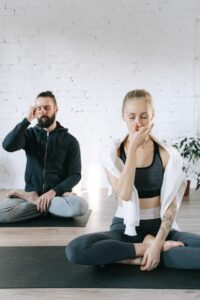
5. A crucial element of meditation is relaxation. Breathe deeply through your nostrils and expand your lungs and diaphragm for a few moments to induce a state of calm. After holding the breath for a short while, slowly release it through your mouth. Repeat this process until you are at ease.
6. You can induce a state of relaxation and calmness by listening to calm, pleasant music.
7. It is not required to meditate on an empty stomach, so if you are hungry, eat a little.
8. Don’t stress about doing anything correctly and set aside your expectations.
Practicing Meditation
Mahamudra is a type of meditation that allows one to approach daily tasks with attention. It is incorporating meditation into every facet of our existence. You can perform the following practice anyplace to cultivate inner tranquility. It is particularly useful when you are caught in traffic, standing in line at the bank or grocery store, working on busy days, or collecting up the kids from activities or school.
Hugh Mulligan wrote, “What I do today is important because I am exchanging a day of my life for it.” We can remember to pause and smell the flowers by practicing meditation. Take a deep breath to start. Take a deep breath and expand both your diaphragm and your lungs. After holding the breath for a short while, slowly release it through your mouth. Clear your mind and concentrate on your breathing. Repeat this several times until your breathing slows down and you experience a profound sensation of calm. As tranquility seeps into your body, pay attention to it. Let go of your shoulders and establish a connection with the energy through the top of your head. Do it again. If you so chose, connect with people’s hearts with love and light to bring them peace.
Meditation While Walking
Walking meditation is just an awareness exercise. There are four parts: Pay attention to how you breathe. Take note of your surroundings. Pay attention to how your body moves, and when you get back home, give your experience some thought.
Bring awareness to your walks wherever you are to develop awareness walking. Pay attention to how you breathe. Do you unknowingly breathe in short, shallow breaths? If so, concentrate on your body and in the here and now by taking a few deep breaths. Be grateful for your amazing body and the gift of being able to walk.
Take note of your surroundings. What time of year is it? Listen to the sounds around you for a few minutes. Feel the snow, rain, fog, wind, or sun on your face. Take in your surroundings, including the sky, trees, buildings, animals, birds, and people. Inhale and exhale and acknowledge that you are an essential component of the surroundings. Be mindful of your body. Do you have tightness in your legs, lower back, solar plexus, shoulders, or neck? If you are experiencing tension, take a deep breath and let it into the earth.
Next, focus on your posture. Do you slouch or are you tall and erect? Walk with your body relaxed and elevated in a manner that suits you. Put one foot in front of the other, walk confidently and with dignity, and focus on the sensation of movement. You can stroll deliberately in the mall, on the sidewalk with your dog, or through the corridors of your place of employment. All you have to do is remind yourself to live in the present and take each step as it comes. Repeating a mantra—sacred words repeated to help you focus—can be beneficial for certain people.
Counting your breaths is another way to apply a variation of the walking mantra. Count the number of steps it takes to breathe in and out while walking more slowly than normal. This kind of meditation brings together a beautiful combination of awareness and tranquility by focusing on both your breathing and your steps.
When you get back home, give your experience some thought. Your walk comes to an end after five or ten minutes, and you have the chance to move from this peaceful spot to regular daily routines.