Researchers say that the average individual has more than 60,000 ideas every day, and 90% of those thoughts are the same ones they had yesterday. Also, people worry about things roughly half the time, and 90% of those anxieties never come true. Meditation can help.
But most of us can recall those wonderful times when we felt complete love, flashes of wisdom and understanding, and a sense of harmony with the universe and with ourselves. If only we could control our busy minds and use them more effectively right now!
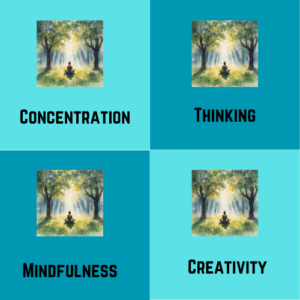
Meditation can help us let go of worries that are not necessary and improve our senses and perception. There are many waysate around the world, but they can be grouped into four main types: concentration meditation, reflective (or insight) meditation, mindfulness meditation, and creative meditation.
Meditation for concentration:
All other types of meditation are based on concentration meditation. To be mentally focused and get rid of distractions, you need to be able to concentrate. If you pour water on a level surface, it will instantly produce a shallow pool of water that will stay still in the low spots. But if you aim this water in one direction and keep it under pressure, it may be powerful. The mind works in a simisimilarlylet it go free, it will not have much power; it will only fill the area it has. But a focused mind can be a strong way to carry out our plans.
When the mind learns to focus, it can become more calm, stable, and clear, which means that problems like confusion, worry, and lack of concentration are no longer an issue. Also, concentration is used in the other main types of meditation, such as mindfulness, introspective, and creative meditation. Furthermore, the ability to focus can be used to improve physical skills.
Meditation that makes you think:
Discipline in thinking can be defined as reflective meditation. You pick an idea, situation, or topic and think about it. When your mind starts to wander, you softly but firmly draw it back to what you are thinking about. This type of meditation is often used to learn more about death, life, the meaning of life, or your own mental journey, whether that journey is about relationships, a scientific conundrum, or everyday concerns. The key to getting enlightening insights is to keep your mind focused on your selected theme and be receptive to whatever comes up as a result of that experience.
Meditation with mindfulness:
Mindfulness is being aware of the present moment, when your mind is calm and aware of everything that is happening, including your thoughts, feelings, sensations, and breathing. You accept everything with an attitude of non-resistance and serenity. So, you can truly experience everything without judging yourself or holding on to your sense of self and worth.
Most of our troubles come from not being conscious of what we are doing and doing things without thinking. Mindfulness can help us focus better, communicate better, deal with stress, get more done, and feel better about ourselves.
Meditation that is creative:
Concentration and mindfulness help us be more aware and focused, but creative meditation helps us change and use our mental habits more effectively. Creative meditation can help us grow and strengthen certain parts of our nature. It can also bring new opportunities and possibilities into our life. One of the most popular ways to meditate creatively is through creative visualization. This can help us achieve our personal goals, including being successful at work or finding happiness.
Our subconscious mind does not differentiate between imaginary and real-life stimuli. Even if an impression may only last a few seconds, the subconscious mind can cause the same emotional, mental, and psychological responses over and over again. So, by making emotionally charged images that we like more aware, we may manage our imagination in a useful way and change the good things about our mind.
We all know that working out frequently can help us build up our strength and flexibility over time. The same rules apply to the mind. Many studies have shown that you can make your mind smarter, more creative, and better at other things. If you meditate regularly, your mind will become clearer, calmer, and stronger. You will then be able to use it mindfully and more effectively in any task or activity.